








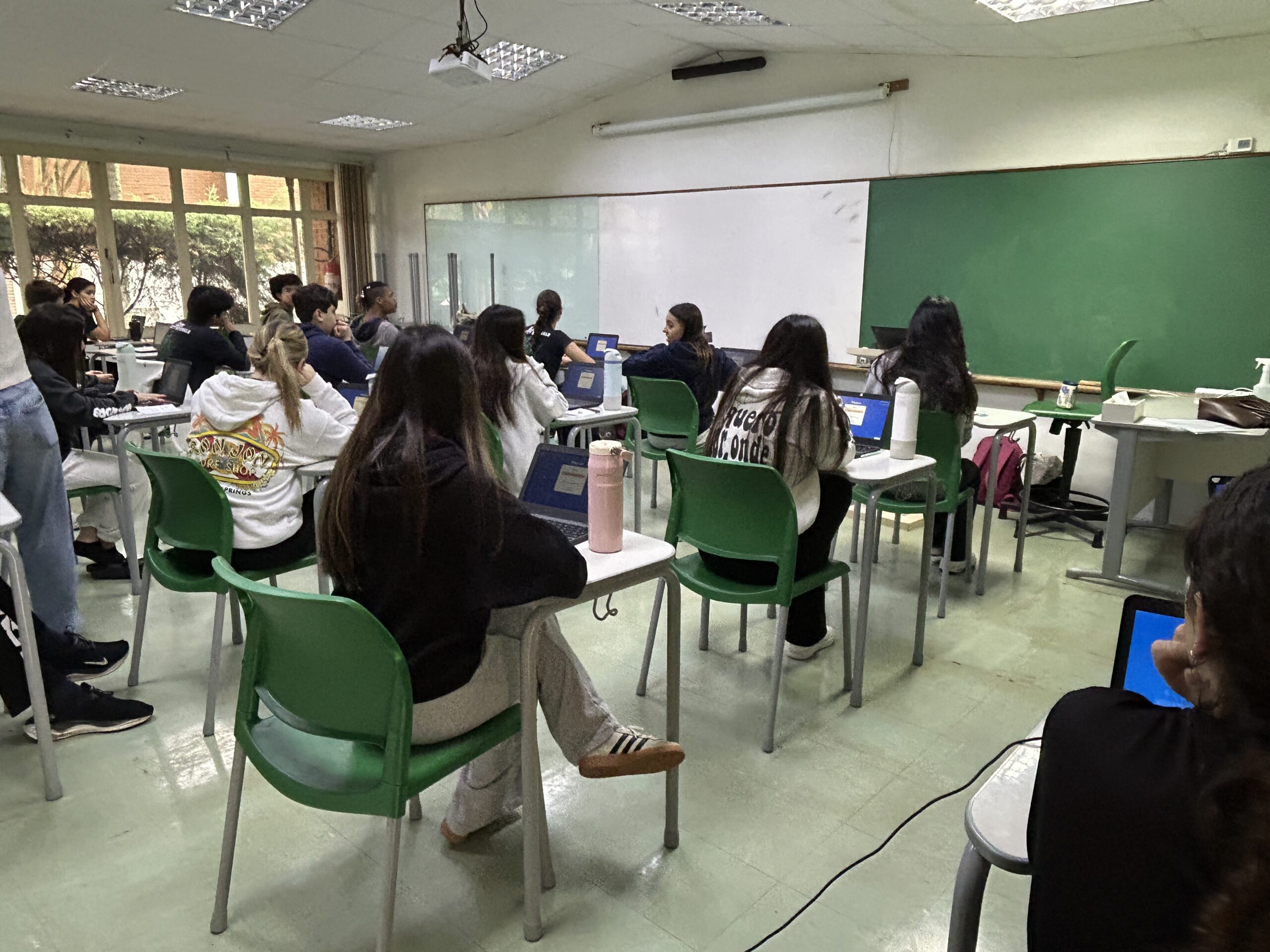
Caption: Students in the 11th grade class are seated and prepare to take the PSAT as the proctor checks everyone’s devices. [by Dr. Cristina Meier]
by Isabella Lázaro
From October 5th to October 6th, the Pan American Christian Academy (PACA) of Sao Paulo, Brazil, provided the PSAT tests to students in 9th through 11th grades as part of the College Board schedule for annual standardized testing to provide high school students with the opportunities to experience this type of testing without the weight of official scores being given to them.
The College Board offers three different areas of support for students who are planning to go to college after finishing high school (standardized tests, college level classes and support in finding a college and career of their choice).
The PSAT stands for Practice or Preview SAT, which used to be known as the “scholastic aptitude test,” and it counts only as a recorded practice test for the SAT.
The PSAT is part of a testing suite to prepare students for the real test that can be used for college applications and possibly scholarship offerings. Students as young as 8th grade can begin taking these practice tests.
At PACA, administration has chosen to continue offering MAP testing to 8th grade and provide the PSAT 8/9 to the ninth grade class only.
The first day of testing was Monday, October 5, and the PSAT 8/9 was administered to the 9th grade class on that day. The 9th graders were given three whole periods to take this test. The test had two parts that were each divided into two modules.
The total test time was 2 hours and 14 minutes, with two reading and writing modules that had a total of 32 minutes of test time, and two math modules that had 35 minutes of test time. There was also a 10 minute break between the English and Math sections.
Catarina Hara, a freshman, likes how the test is divided.
“I think that it’s helpful how the test is split into two modules, and I enjoyed how the second module was more challenging than the first one,” said Hara.
The first part was English, which includes reading comprehension, grammar, vocabulary, and analyzing passages. Everyone starts at the same difficulty. Students progress depending on how well they did on the first module. The increased difficulty was determined within the second module.
The second part of the test was focused on Math. The math problems included Algebra, Linear equations, System of equations, Quadratics, Functions, Ratios and percentages, Geometry, Data analysis and more. The Math modules of the PSAT had a total of six minutes more than English.
The second day of testing provided the opportunity for the 10th and 11th grade classes to participate in different levels of PSAT offerings. The 10th grade class took the PSAT 10 while the 11th grade class took the PSAT/NMSQT Test. The letters “NMSQT” stand for national merit scholarship qualifying test and this test is only offered to 11th grade students who are U.S. citizens and have taken the PSAT 10 in 10th grade.
For freshmen and sophomores, the PSAT is important because it establishes a baseline that shows them what skills they have and what skills they need to improve in. It serves as a practice so the students build familiarity with the testing style.
The PSAT is really important for juniors because it serves as the official National Merit Scholarship Qualifying Test, where top scorers can get major college money. It also qualifies students for other selective programs. And finally, it also serves as a final practice for those who plan to take the SAT and submit those scores to the colleges and universities they are applying to enter.
The PSAT reminds students of the previously taken MAP tests, because they have taken on the same format ever since the tests became digital in recent years.